
Cleaning, Pressing, and Restoration Risks Before Card Grading
Gentle prep and risky intervention are not the same thing. Some actions are basic care. Others create new damage, suspicion, or both.
Last reviewed: April 2026. Service information, grading standards, and market context were checked against current hobby guidance and official source pages where applicable.
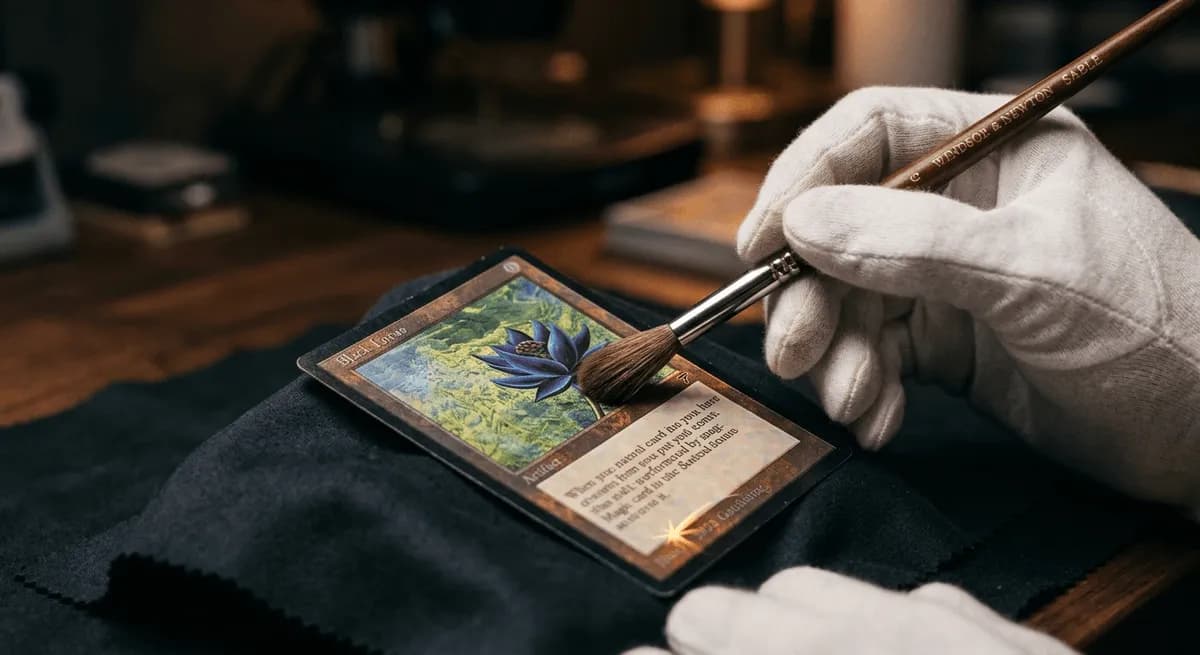
Collectors often hear vague advice to "clean the card" or "see if you can fix that dent." That is where trouble starts. Light dust removal and safe handling are one thing. Attempts to alter the surface, flatten defects, or improve appearance beyond ordinary care can create new risk fast.
Low-risk care versus high-risk intervention
Usually safer basics
- Careful dry dust removal
- Fresh sleeve and clean workspace
- Better inspection light and photos
- Proper submission packaging
Higher-risk moves
- Pressing dents or bends flat
- Using liquids or chemicals casually
- Surface polishing or heavy rubbing
- Trying to hide or improve structural damage
Why pressing and restoration are dangerous
Even if a card looks better immediately after intervention, you may have changed texture, gloss, or fiber integrity in a way that still reads as a problem. Many collectors convince themselves they are "just helping the card." In practice, they often make the flaw harder to assess while adding new concerns.
When a card should simply stay as-is
If a card has a binder dent, crease, deep scratch, or other structural defect, the safer choice is usually honest evaluation rather than home repair. Decide whether it still deserves submission, a collection slab, or a raw sale. Trying to transform a compromised card into a stronger one is where losses compound.
If you are unsure what counts as basic prep, start with How to Clean Trading Cards Before Gradingand keep the process conservative.
A better pre-grading plan
- Confirm the card is worth spending time on.
- Use safe handling and light cleaning only.
- Inspect honestly under strong light.
- Pre-screen with Master Grade.
- Submit only if the card still works without risky intervention.
Safe prep protects value. Risky fixes usually do the opposite.
If the submission only works after a questionable repair, it probably never worked.
Related: How to Clean Trading Cards Before Grading, Binder Dent and Print Line Edge Cases, and Grading FAQ
Related Articles

Day 1 of the 2026 Pokémon Los Angeles Regional Championships now underway featuring Pokémon VGC, Pokémon TCG and Pokémon GO events, tune in to the official livestream feeds here
The 2026 Pokémon Los Angeles Regionals are underway! Learn what this means for card collectors and how MasterGrade AI grading can help maximize value.
May 9, 2026 · 2 min read
Day 1 of the 2026 Pokémon Los Angeles Regional Championships now: what it means for collectors
Day 1 of the 2026 Pokémon Los Angeles Regionals is underway! Learn how the event impacts card values and your collection. Grade smarter with MasterGrade.
May 9, 2026 · 4 min read
Pokémon TCG: Mega Evolution — Chaos Rising launch promo features Ho-Oh, Keldeo and Delphox cards at select retailers
New Pokémon TCG "Mega Evolution — Chaos Rising" promo featuring Ho-Oh, Keldeo, and Delphox cards is here! Learn how it impacts card collectors!
May 9, 2026 · 2 min read
Pokémon TCG: Mega Evolution — Chaos Rising launch promo features: what it means for collectors
The Pokémon TCG Mega Evolution Chaos Rising launch promos are here! Learn how to acquire, assess, and grade these valuable Ho-Oh, Keldeo & Delphox cards.
May 9, 2026 · 4 min read