
Binder Dent, Print Line, or Centering Issue? Edge Cases That Change Grades
The hardest grading decisions are rarely the obvious ones. They are the tiny flaws that seem harmless until they quietly knock a card out of premium territory.
Last reviewed: April 2026. Service information, grading standards, and market context were checked against current hobby guidance and official source pages where applicable.
Most collectors can spot a crease or a bent corner. The real losses usually come from gray-zone defects: a shallow binder dent, a faint print line, or centering that looks acceptable until you actually measure it. These are the defects that turn a "probably a 10" card into a 9 or worse.
Binder dents usually matter more than collectors want to believe
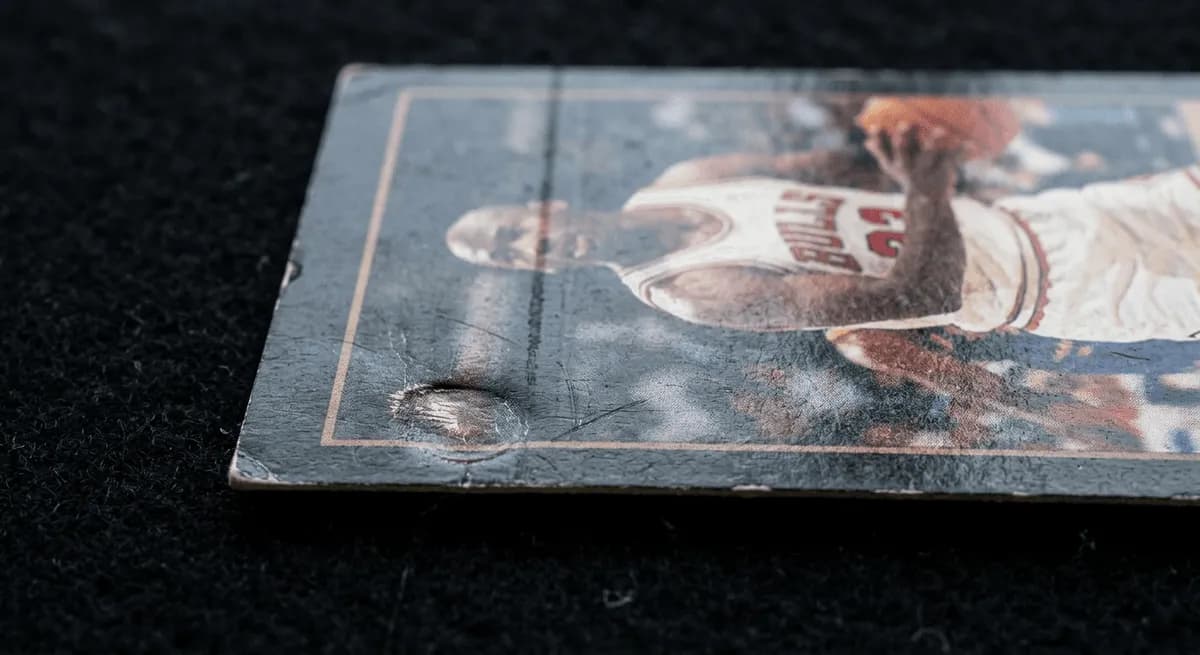
A binder dent can be hard to see head-on, especially on textured or glossy cards. Under angled light, though, it often shows up clearly enough to become a real surface issue. If you can see it when tilting the card, assume a grader can too.
Print lines are still defects even when they are factory-made
Print lines come from production, but that does not make them harmless. Visibility, placement, and severity all matter. A faint line near an edge is not the same as a strong line cutting through the art. The more obvious the line in normal viewing, the more it can affect both grade ceiling and buyer confidence.
Borderline centering needs measurement, not vibes
Human eyes are bad at judging near-threshold centering. If a card looks close, stop guessing and measure. Use straight-on photos or revisit the centering guide before you assume a premium grade is still on the table.
Quick edge-case cues
- Binder dent visible under angled light: treat it as a genuine downgrade risk.
- Print line across the focal area: assume it affects both eye appeal and grade ceiling.
- Centering that feels "close enough": measure it before building expectations.
- Multiple minor flaws together: the stack matters more than any one defect alone.
Do not let pack-fresh bias fool you
Many edge-case defects are factory issues, not handling damage. That is why collectors miss them. Pack-fresh can still mean print line, roller mark, rough cut, or off-centering. Treat the card in front of you, not the story of how you pulled it.
Best workflow for gray-zone defects
- Photograph the front and back straight on.
- Inspect under angled light for dents, scuffs, and print lines.
- Measure centering if it looks close.
- Use Master Grade for an initial screen.
- Only submit if the likely grade still works against pricing.
Gray-zone defects are where submission money disappears.
Slow down on the edge cases and your hit rate gets better fast.
Related: Edge Whitening Guide, Sports Card Surface Defects, and Should You Grade Pack-Fresh Pulls?
Related Articles

Day 1 of the 2026 Pokémon Los Angeles Regional Championships now underway featuring Pokémon VGC, Pokémon TCG and Pokémon GO events, tune in to the official livestream feeds here
The 2026 Pokémon Los Angeles Regionals are underway! Learn what this means for card collectors and how MasterGrade AI grading can help maximize value.
May 9, 2026 · 2 min read
Day 1 of the 2026 Pokémon Los Angeles Regional Championships now: what it means for collectors
Day 1 of the 2026 Pokémon Los Angeles Regionals is underway! Learn how the event impacts card values and your collection. Grade smarter with MasterGrade.
May 9, 2026 · 4 min read
Pokémon TCG: Mega Evolution — Chaos Rising launch promo features Ho-Oh, Keldeo and Delphox cards at select retailers
New Pokémon TCG "Mega Evolution — Chaos Rising" promo featuring Ho-Oh, Keldeo, and Delphox cards is here! Learn how it impacts card collectors!
May 9, 2026 · 2 min read
Pokémon TCG: Mega Evolution — Chaos Rising launch promo features: what it means for collectors
The Pokémon TCG Mega Evolution Chaos Rising launch promos are here! Learn how to acquire, assess, and grade these valuable Ho-Oh, Keldeo & Delphox cards.
May 9, 2026 · 4 min read