
Should You Grade Your Cards? A Decision Framework for Collectors
Grading costs $15—“$150 per card and takes weeks. Sometimes it doubles your value. Sometimes it destroys it. Here's how to think through the decision systematically.

Last reviewed: April 2026. Service information, grading standards, and market context were checked against current hobby guidance and official source pages where applicable.
The number one question in card collecting is: “Should I grade this?” It sounds simple, but the answer depends on five distinct variables that most collectors never fully evaluate before dropping $30—“$150 per card on a submission. This framework will help you make the right call every time.
The Five Grading Variables
1. Raw Value vs. Grading Cost
The most basic calculation: what is the card worth raw, and what does it cost to grade? PSA's cheapest tier runs $30 and their standard economy service is $50—“$75 for most cards. BGS and CGC have similar pricing.
Minimum viable value thresholds:
- 🔴 Under $50 raw → Almost never worth grading (fees eat any premium)
- 🟡 $50—“$150 raw → Only if you have a realistic PSA 10 candidate
- 🟢 $150—“$500 raw → Grade if condition is strong (PSA 9+ likely)
- ✅ $500+ raw → Almost always grade; premium is substantial
2. Expected Grade Realism
What grade can you actually expect? This is where most collectors go wrong — they assume their card will grade higher than it will. PSA 10 is rarer than most people think. For many modern cards, fewer than 5—“10% of submitted copies receive a gem mint.
A PSA 9 sells for 1.5—“3x raw NM value. A PSA 10 sells for 5—“20x. A PSA 7 often sells for less than raw because the grade confirms flaws. If you have honest doubts about corners or centering, a PSA 7 return is a real possibility.
Get an AI pre-assessment before submitting →3. Your Goal: Investment vs. Collection
Grading for resale and grading for a personal collection have different economics.
Resale Focus
- ✓ PSA maximizes market premium
- ✓ Grade only PSA 9+ candidates
- ✓ Focus on liquid, high-demand cards
- ✓ Time submission to market peaks
Collection Focus
- ✓ BGS/CGC for sub-grade detail
- ✓ Grade cards with personal meaning
- ✓ Protection is valuable regardless of grade
- ✓ PSA 8 is still a beautiful slab
4. Market Timing
Grading turnaround currently runs 3—“12 weeks depending on service tier. If you submit during a market peak for your card, it may be 20% cheaper by the time you get it back. Conversely, submitting before a set anniversary or major tournament can position you perfectly.
For vintage cards with stable long-term appreciation, timing matters less. For modern hot cards, timing can make or break your ROI.
5. Liquidity: Can You Actually Sell It Graded?
A graded card with no active market is worse than a raw card — the slab makes it harder to sell, and the lower liquidity means longer wait times to find a buyer. Always verify that graded copies of your specific card have recent sales before submitting.
Check eBay's “Sold” filter for graded copies. If there are fewer than 3 sales in the past 90 days, liquidity is a concern.
The Decision Tree
Run your card through this mental decision tree before submitting:
START: Is the raw card worth >$100?
→ NO: Don't grade. Fees kill any premium.
→ YES: Continue ↓
Can this card realistically grade PSA 9+?
→ NO: Don't grade. Risk of a confirming-flaw PSA 7/8.
→ UNSURE: Use AI pre-assessment first.
→ YES: Continue ↓
Does a PSA 9+ add meaningful value vs. raw?
→ NO (less than 2x): Grade for protection only if collecting.
→ YES (3x or more): Grade immediately.
Are there active graded sales in the market?
→ NO: Grade for collection, not investment.
→ YES: Proceed with submission.
Cards That Almost Always Make Sense to Grade
- â-1st Edition vintage holos in NM+ condition — The grading premium is enormous and the authentication value is real. Even a BGS/CGC label protects against counterfeits.
- â-High-value modern alt-arts and SIRs pulled fresh from packs — New cards from sealed product have the best chance of PSA 10. Grade immediately before any handling degrades them.
- â-Promo cards and tournament exclusives — Authentication adds as much value as grade here. Buyers pay a premium just to know the card is genuine.
- â-Cards you plan to keep long-term — A slab protects against degradation. Even a PSA 8 is frozen in condition forever.
Cards That Almost Never Make Sense to Grade
- â-Commons and uncommons under $50 raw — The math simply doesn't work. Even a PSA 10 premium won't cover fees plus time cost.
- â-Cards with visible wear you're hoping the grader will overlook — They won't. You'll spend $50 to get back a PSA 6 that's worth less than raw.
- â-Cards from sets with no graded market activity — If nobody buys graded copies, the slab adds no value.
- â-Cards you might want to play with or trade casually — Slabbed cards can't be used in play and reduce trade flexibility.
The Pre-Screening Habit That Saves Money
The smartest collectors have adopted a universal pre-screening rule: before any card goes in a submission box, it gets an AI assessment first. This takes 30 seconds and can save you from paying to confirm a card's flaws.
Master Grade gives you a complete breakdown — centering ratios, corner assessment, edge analysis, and surface evaluation — exactly what a grader sees. If the AI sees a PSA 7, so will the grader.
Pre-screen before you submit.
Instant AI grading assessment — free to try.
Also see: Graded vs Raw: When Does Grading Actually Add Value? and our frequently asked questions.
Related Articles
Which Cards Are Worth Grading? A Decision Framework
Not every card is worth the $30+ grading fee. Learn the value thresholds, condition cutoffs, and market signals that make a card worth submitting.
March 31, 2026 · 7 min read
What Cards Are Not Worth Grading? A Collector Reality Check
The common submission types that usually fail the fee-versus-upside test, plus a cleaner rejection filter for collectors.
April 1, 2026 · 8 min read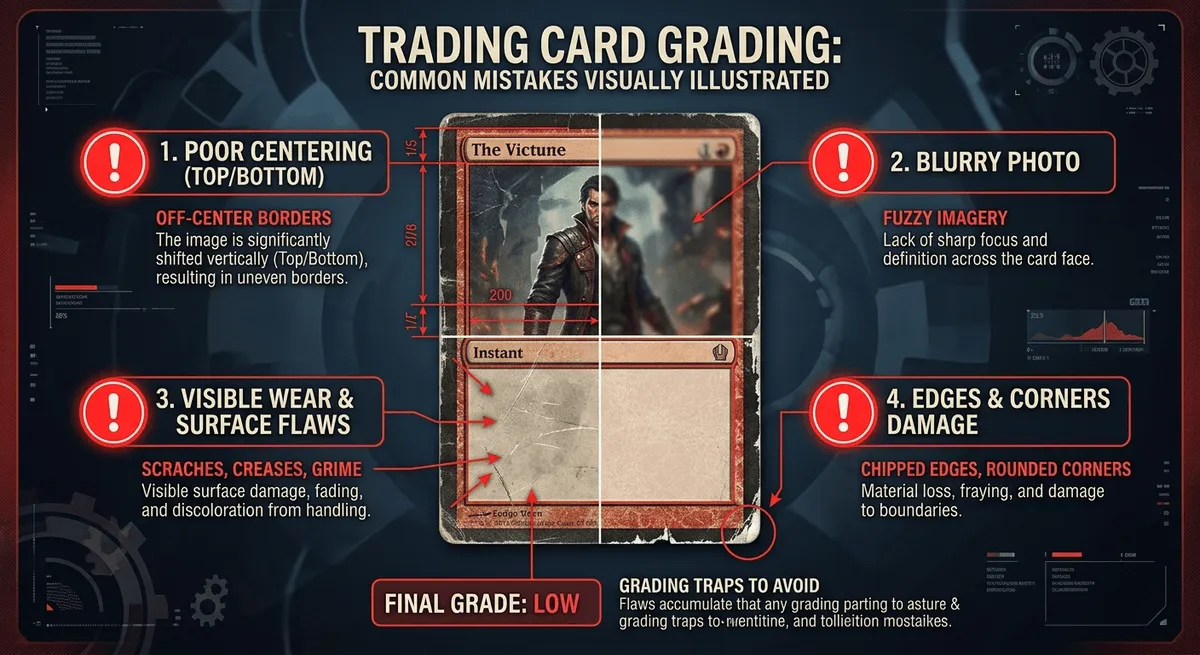
Common Card Grading Mistakes to Avoid Before You Submit
The avoidable errors that waste grading fees: weak screening, bad photos, wrong service choice, sloppy packing, and emotion-driven submissions.
April 1, 2026 · 8 min read
When to Submit Cards for Grading: Timing, Market, and Condition
A practical timing framework for grading decisions based on card condition, market window, fee structure, and downside risk.
April 1, 2026 · 7 min read