
Graded vs Raw: When Does Professional Grading Actually Add Value?
Grading adds value for some cards and destroys it for others. Here's the data-driven framework for knowing which is which — before you spend submission money finding out the hard way.
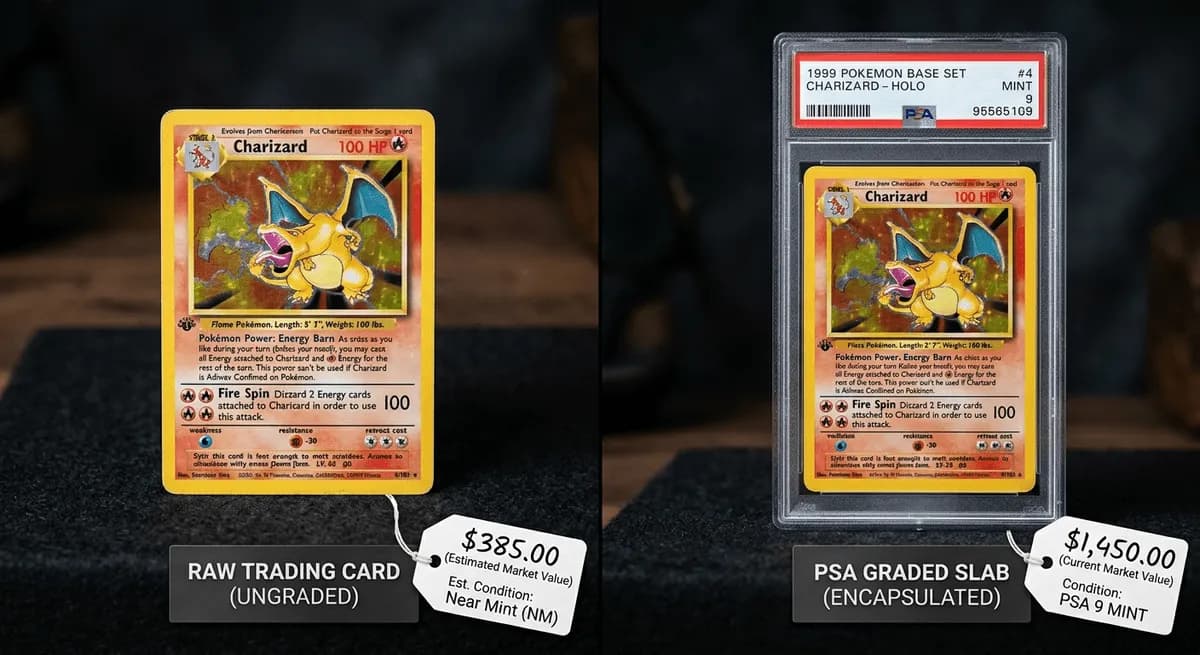
Last reviewed: April 2026. Service information, grading standards, and market context were checked against current hobby guidance and official source pages where applicable.
The question every collector eventually asks is whether grading is worth it. The short answer: it depends entirely on the card, the expected grade, and the market. The longer answer involves understanding exactly how grading multipliers work, when raw cards actually sell for more, and how to calculate your real break-even before submitting.
This guide will give you a systematic framework — not vibes-based guesses — for every grading decision you make.
The Four Value Scenarios
Every card you consider grading falls into one of four scenarios. Knowing which one applies to your card determines the right decision.
Scenario A: Grading Multiplies Value Significantly
Card is genuinely PSA 10 quality. Raw NM value is above $150. Active graded market exists. PSA 10 sells for 5—“20x the raw NM price.
Decision: Grade immediately. This is the best possible grading scenario.
Example:
Umbreon VMAX Alt-Art raw NM: $350 → PSA 10: $3,200
Net gain after ~$100 grading fee: +$2,750
Scenario B: Grading Adds Modest Value
PSA 9 expected, not PSA 10. Or PSA 10 expected on a card with a modest multiplier (2—“4x raw). Net gain after fees is positive but not dramatic.
Decision: Grade if you want protection/authentication. Skip if purely maximizing ROI.
Example:
Modern holo raw NM: $80 → PSA 9: $180 (2.25x multiplier)
Net gain after ~$40-50 all-in grading cost: +$50 to +$60 (marginal)
Scenario C: Grading Breaks Even or Slightly Negative
Card grades PSA 8—“9 and the premium barely covers submission costs. Or the card value is too low for fees to make sense even at PSA 10.
Decision: Don't grade for investment. Grade only if you specifically want a slab for your personal collection.
Example:
Card raw NM: $40 → PSA 9: $85 (2.1x) → PSA 10: $150 (3.75x)
Net gain after ~$40-50 all-in cost: +$35 to +$45 (PSA 9) or +$100 to +$110 (PSA 10, if it happens)
Scenario D: Grading Destroys Value
Card comes back PSA 7 or lower. The grade confirms flaws that were previously uncertain to buyers. A PSA 7 often sells for less than the same card raw because buyers now know exactly what's wrong with it.
Decision: Never submit a card that you're uncertain about. Pre-screen first — every time.
Example:
Card raw: could sell as “NM” for $200 → PSA 7: sells for $120
Net result: −$130 (loss + grading fee + now confirmed worse)
Grading Multipliers by Card Type
The “grading multiplier” is the ratio of a graded card's sale price to its raw NM equivalent. Understanding typical multipliers by card category helps you set realistic expectations.
The Break-Even Formula
Before submitting any card, run this calculation. It takes 2 minutes and prevents costly mistakes.
Break-Even Calculation
1. Raw NM value = $___
2. Grading cost (submission + return shipping) = $___
3. Expected grade: PSA ___
4. Expected sale price at that grade = $___
5. Selling fees (eBay ~13%) = $___
Net value = (4) − (1) − (2) − (5)
If Net value > $0: Grading adds financial value
If Net value < $0: Raw is better (for investment purposes)
Worked Example: Charizard ex SIR (Obsidian Flames)
Raw NM value: $220
PSA Economy submission: ~$20
Return shipping estimate: $12
Expected grade: PSA 10 (optimistic — 15% probability) or PSA 9 (60% probability)
PSA 10 expected sale: $1,200 → eBay fees ~$156 → net: +$762
PSA 9 expected sale: $450 → eBay fees ~$59 → net: +$109
Expected value (probability-weighted):
0.15 Ã- $762 + 0.60 Ã- $109 + 0.25 Ã- (−$50) = $114 + $65 − $13 = +$166 expected net gain
Conclusion: Grade this card. The expected value is positive even accounting for PSA 8 risk.
When Raw Cards Are Worth More
There's a scenario that surprises many newer collectors: sometimes a raw card sells for morethan a graded equivalent in the same condition. This happens in a few specific situations:
1. Cards with No Graded Market
If no one buys graded copies of your card, a PSA slab adds zero liquidity premium. You've spent $50 and made the card harder to sell in the much-larger raw market. Always verify active graded sales before submitting.
2. Low-Grade Results on High-Value Cards
A PSA 6 on a card with significant raw NM value is worse than just selling it raw. The grade label now tells every buyer exactly what's wrong with the card — removing the uncertainty that sometimes lets raw cards command near-NM prices.
3. Cards Players Want to Actually Use
Modern tournament staples are sometimes worth more raw to players who need to use them in decks. A $200 competitive MTG land in a PSA 9 slab can't be sleeved and played. The raw version has higher practical demand from the tournament community.
4. Cards During Market Corrections
If you submit a card during a price peak and the market corrects 30% before you get the slab back, your ROI math can flip negative even on a PSA 9. Vintage cards are less volatile; modern hot cards carry timing risk on 4—“12 week turnarounds.
The Hidden Value: Authentication
For vintage cards, grading adds a benefit beyond the numeric premium: authentication. A PSA-slabbed 1st Edition Base Set Charizard comes with Fraud protection built into the label. The grading company has certified the card is genuine — a material benefit for a card where high-quality fakes and trimmed/altered copies circulate in the wild.
Authentication value is hardest to quantify but most significant for:
- Any vintage card worth over $500 raw — fake risk is proportional to value
- Japanese exclusive promos with limited paper trails
- High-value YGO first editions (LOB, MRD, MRL era)
- Tournament prize cards and game-show promos
- Any card purchased online from an unknown seller
Pre-Screening: The Step That Changes the Math
The single most impactful change you can make to your grading economics is adopting a systematic pre-screening process. Pre-screening with an AI grading tool before any submission eliminates Scenario D (value destruction) and improves your grade hit rate on Scenario A candidates.
Here's how the math changes with pre-screening:
Without pre-screening (10 cards)
- 2 Ã- PSA 10 → +$400 each
- 4 Ã- PSA 9 → +$80 each
- 3 Ã- PSA 8 → −$20 each
- 1 Ã- PSA 7 → −$60 (value destruction)
- Net: +$1,020
With pre-screening (10 candidates → 7 submit)
- 2 Ã- PSA 10 → +$400 each
- 4 Ã- PSA 9 → +$80 each
- 1 Ã- PSA 8 → −$20
- 3 Ã- Skipped (saved $150 in fees)
- Net: +$1,270
*Illustrative example. Actual results depend on specific cards and market conditions. Pre-screening improves outcomes by eliminating high-risk, low-reward submissions.
The Bottom Line: A Simple Rule
Grade a card if ALL of these are true:
- ✓ The raw value is high enough to justify the fee (generally $100+ minimum)
- ✓ You have reason to believe the card can achieve PSA 9 or better
- ✓ There is an active market for graded copies (verify via sold listings)
- ✓ The expected net value calculation is positive (run the math)
Skip grading if ANY of these are true:
- âœ- Raw value under $100 (fees consume any premium)
- âœ- You can see visible condition issues (edge whitening, corner wear, surface scratches)
- âœ- No active graded sales market for this card
- âœ- You might want to use, trade, or modify the card
Know before you submit.
Get an instant AI pre-assessment — the fastest way to know if your card is worth grading.
Related reading: Should You Grade Your Cards? A Decision Framework and Master Grade FAQ.
Related Articles
Is AI Card Grading Accurate? What to Expect in 2026
AI card grading has exploded in popularity. We break down how accurate it really is, when to trust it, and when you still need a human grader.
March 31, 2026 · 5 min read
Day 1 of the 2026 Pokémon Los Angeles Regional Championships now underway featuring Pokémon VGC, Pokémon TCG and Pokémon GO events, tune in to the official livestream feeds here
The 2026 Pokémon Los Angeles Regionals are underway! Learn what this means for card collectors and how MasterGrade AI grading can help maximize value.
May 9, 2026 · 2 min read
Day 1 of the 2026 Pokémon Los Angeles Regional Championships now: what it means for collectors
Day 1 of the 2026 Pokémon Los Angeles Regionals is underway! Learn how the event impacts card values and your collection. Grade smarter with MasterGrade.
May 9, 2026 · 4 min read
Pokémon TCG: Mega Evolution — Chaos Rising launch promo features Ho-Oh, Keldeo and Delphox cards at select retailers
New Pokémon TCG "Mega Evolution — Chaos Rising" promo featuring Ho-Oh, Keldeo, and Delphox cards is here! Learn how it impacts card collectors!
May 9, 2026 · 2 min read