
Pokémon Card Authenticity Red Flags: How to Spot Fakes Before Grading
Before you think about grade potential, make sure the card is real. Condition analysis is pointless on a fake.
Last reviewed: April 2026. Service information, grading standards, and market context were checked against current hobby guidance and official source pages where applicable.
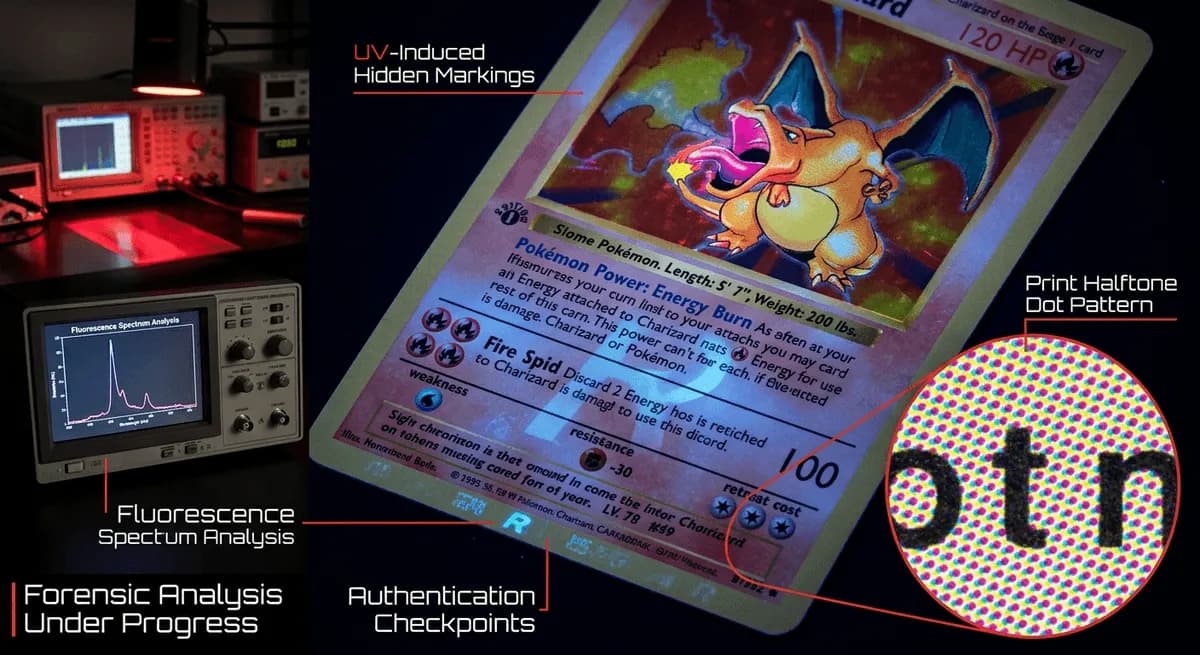
The biggest authenticity mistake collectors make is assuming a card that looks old, shiny, or expensive must be legitimate. Fake Pokémon cards range from terrible to surprisingly convincing. The good news: many still reveal themselves through repeatable red flags.
Start with the obvious print signals
Wrong colors
The back blue may look too dark, too purple, or washed out compared with a known real copy.
Soft or muddy text
Legitimate cards usually have cleaner font edges and stronger print clarity.
Suspicious borders
Borders that look too thick, too thin, or uneven in the wrong way can indicate a counterfeit.
Incorrect holo effect
Fake holo patterns often look generic, overly rainbow, or inconsistent with the real set.
Texture matters on modern chase cards
Many modern ultra rares and alternate arts use specific texture patterns. Counterfeits often miss the texture entirely or apply a fake embossed pattern that looks wrong under angled light. If the card should have texture and the surface feels flat or random, stop and investigate further.
Compare against a confirmed real copy
The fastest authenticity check is side-by-side comparison. Match font weight, border tone, holo behavior, card stock feel, and back color against a known authentic example from the same set. If you cannot do that physically, use /identify to confirm the exact card version first so you know what you should be comparing.
Watch for fake aging on vintage-style cards
Some counterfeiters understand that perfect-looking vintage cards can raise suspicion, so they add artificial wear. Be careful with cards that have odd whitening, unnatural bending, or surface grime that looks staged rather than earned. Fake wear tends to look inconsistent with how real cards age.
Red flags in seller photos
- Only one blurry angle of an expensive card.
- Heavy glare hiding the holo or texture.
- No back photo.
- Multiple expensive cards with identical lighting and suspiciously similar condition.
- Descriptions that dodge specifics about set, numbering, or authenticity.
Do not confuse authenticity review with grading review
A real card can still grade badly, and a fake card can look sharp in photos. Run authenticity checks first, then evaluate condition. If the card clears that hurdle, use /grade for condition screening and consult /faqif you are unsure how to interpret the result.
Already slabbed? Verify the cert first.
If the card you're evaluating is already in a PSA holder, the fastest authenticity check is a free PSA cert lookup. Enter the cert number, and PSA's database tells you what card was actually graded and what grade it received. Mismatched data is almost always a fake slab.
When to walk away
If multiple details feel off and the seller cannot provide better photos, more provenance, or matching comparisons, walking away is usually cheaper than trying to rescue the deal. Authenticity uncertainty is a bad place to start a grading submission.
Verify first. Grade second.
Use card identification and better photos before you spend time on value or condition assumptions.
Related: How to Photograph Trading Cards, Which Cards Are Worth Grading?, and PSA vs BGS vs CGC.
Related Articles

Day 1 of the 2026 Pokémon Los Angeles Regional Championships now underway featuring Pokémon VGC, Pokémon TCG and Pokémon GO events, tune in to the official livestream feeds here
The 2026 Pokémon Los Angeles Regionals are underway! Learn what this means for card collectors and how MasterGrade AI grading can help maximize value.
May 9, 2026 · 2 min read
Day 1 of the 2026 Pokémon Los Angeles Regional Championships now: what it means for collectors
Day 1 of the 2026 Pokémon Los Angeles Regionals is underway! Learn how the event impacts card values and your collection. Grade smarter with MasterGrade.
May 9, 2026 · 4 min read
Pokémon TCG: Mega Evolution — Chaos Rising launch promo features Ho-Oh, Keldeo and Delphox cards at select retailers
New Pokémon TCG "Mega Evolution — Chaos Rising" promo featuring Ho-Oh, Keldeo, and Delphox cards is here! Learn how it impacts card collectors!
May 9, 2026 · 2 min read
Pokémon TCG: Mega Evolution — Chaos Rising launch promo features: what it means for collectors
The Pokémon TCG Mega Evolution Chaos Rising launch promos are here! Learn how to acquire, assess, and grade these valuable Ho-Oh, Keldeo & Delphox cards.
May 9, 2026 · 4 min read