
Pokémon Card Centering Guide: How to Measure and What Grades Mean
Centering is the single most common reason cards miss a PSA 10. Learn to measure it precisely, understand grade thresholds, and know when off-centering kills a submission.
Last reviewed: April 2026. Service information, grading standards, and market context were checked against current hobby guidance and official source pages where applicable.
Of the four grading criteria — centering, corners, edges, and surface — centering is the only one you can measure precisely at home before submitting. It's also one of the most common reasons otherwise perfect cards come back as PSA 9 instead of PSA 10. Understanding centering deeply can save you significant money on wasted submissions.
What Is Card Centering?
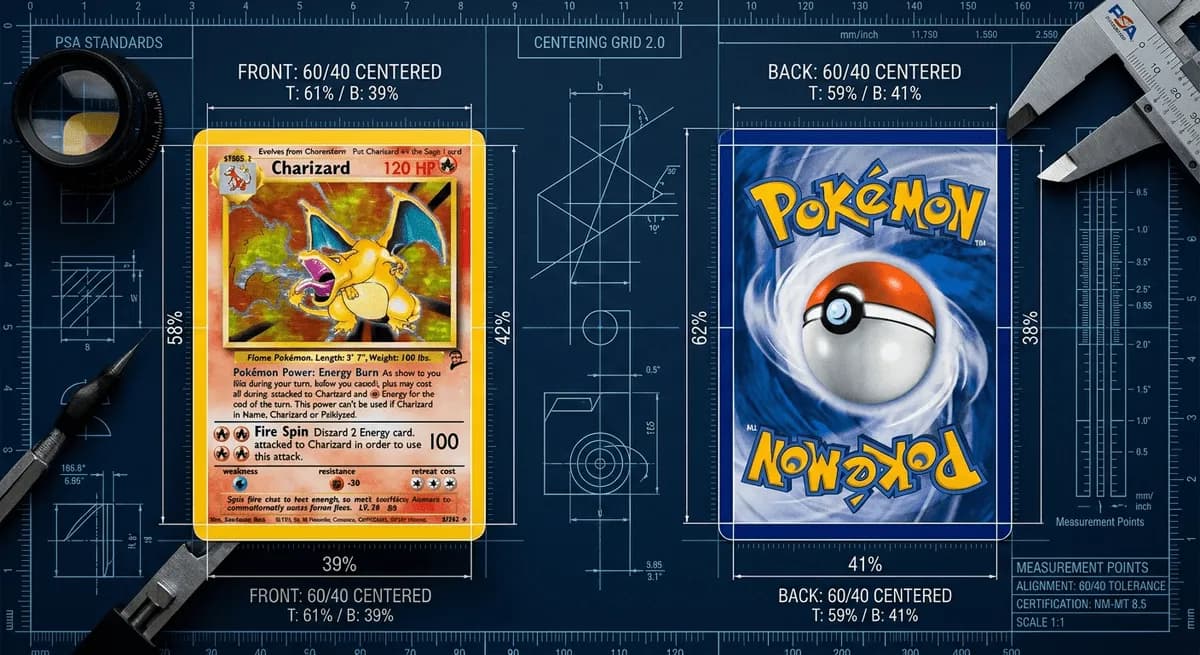
Centering refers to how well the printed image is positioned within the physical card borders. A perfectly centered card has equal white (or colored) border width on all four sides. Because Pokémon cards are printed in large sheets and then cut, slight misalignment between the printing and the cutting process creates off-centering.
Centering is expressed as a ratio comparing the left border to the right border (horizontal centering) and the top border to the bottom border (vertical centering). A perfectly centered card is 50/50 on both axes.
How to Read Centering Ratios
A centering ratio like “60/40” means one border is 60% of the total border space and the other is 40%. In practice, you measure both borders, add them together, then calculate each as a percentage of the total.
How to Measure Centering at Home
You don't need expensive equipment. The most reliable home methods:
Method 1: Digital Calipers (Most Accurate)
A $15—“$20 digital caliper from any hardware store measures borders to 0.01mm precision. Measure each border individually, then calculate the ratio. This is the most reliable method and gives you the same accuracy as professional tools.
âš ï¸ Be careful not to scratch the card surface when placing the caliper.
Method 2: Ruler and Math
A standard ruler works but limits precision to 0.5mm increments. Place the card flat and measure each border carefully. Good enough to identify obvious miscentering (>60/40) but may miss borderline cases.
Method 3: AI Photo Analysis
Upload a high-resolution photo of your card to an AI grading tool and get centering analysis instantly. AI can detect centering from border pixel ratios across both axes. Best used as a quick first-pass before confirming with physical measurement.
Try AI centering analysis →Grade Thresholds by Service
Note: BGS has stricter centering requirements than PSA for top grades. A card that would receive PSA 10 centering may only score a BGS 9.5 centering sub-grade. CGC standards are broadly similar to PSA.
How Much Does Centering Affect Value?
For vintage Pokémon cards, centering is often the difference between a PSA 9 (worth $500) and a PSA 10 (worth $5,000). The grade spread directly reflects the difficulty of achieving perfect centering — many collectors never find a PSA 10 of their target card.
For modern cards, the impact is less dramatic but still significant. A PSA 10 typically commands 3—“8x the raw price versus 1.5—“3x for a PSA 9. If your card has 58/42 centering — borderline PSA 10 territory — it's worth the submission gamble. If you're at 63/37, expect a PSA 9 at best.
The Golden Rules of Centering
- → Always measure BOTH axes — a card can be perfect horizontally but terrible vertically
- → Check the back too — PSA uses a relaxed back standard (75/25) but it still matters
- → Centering can look different depending on lighting — measure, don't just eyeball
- → For bulk submissions, pre-screen centering first to avoid wasting fees on PSA 8 candidates
- → Japanese cards have better average centering than English prints from the same era
Common Centering Misconceptions
⌠Myth: “It looks centered to me, so it's fine”
Human eyes are bad at detecting 55/45 vs 60/40. A 1mm difference across a card border looks almost invisible. Always measure.
⌠Myth: “PSA only checks front centering”
PSA checks both front and back. The back standard is more lenient (75/25 for PSA 10) but a severely off-center back can still cap the grade.
⌠Myth: “A little off-centering won't hurt a great card”
Centering has a hard cutoff. 56/44 might get a PSA 10. 57/43 might not. Graders measure — they don't judge by feel.
Centering and Card Photography
When submitting photos for AI grading or even for sale listings, centering is most accurately captured with the card laid flat on a plain, contrasting surface with the camera directly overhead (no angle). Any tilt in the camera creates apparent centering distortion that can fool both humans and AI systems.
Master Grade's AI is trained to correct for minor camera angle distortion, but a straight-on photo will always produce the most accurate centering analysis. Check our photography tips for the ideal setup.
Get an instant centering analysis.
Upload your card photo and Master Grade will analyze centering, corners, edges, and surface in seconds.
Related Articles

Day 1 of the 2026 Pokémon Los Angeles Regional Championships now underway featuring Pokémon VGC, Pokémon TCG and Pokémon GO events, tune in to the official livestream feeds here
The 2026 Pokémon Los Angeles Regionals are underway! Learn what this means for card collectors and how MasterGrade AI grading can help maximize value.
May 9, 2026 · 2 min read
Day 1 of the 2026 Pokémon Los Angeles Regional Championships now: what it means for collectors
Day 1 of the 2026 Pokémon Los Angeles Regionals is underway! Learn how the event impacts card values and your collection. Grade smarter with MasterGrade.
May 9, 2026 · 4 min read
Pokémon TCG: Mega Evolution — Chaos Rising launch promo features Ho-Oh, Keldeo and Delphox cards at select retailers
New Pokémon TCG "Mega Evolution — Chaos Rising" promo featuring Ho-Oh, Keldeo, and Delphox cards is here! Learn how it impacts card collectors!
May 9, 2026 · 2 min read
Pokémon TCG: Mega Evolution — Chaos Rising launch promo features: what it means for collectors
The Pokémon TCG Mega Evolution Chaos Rising launch promos are here! Learn how to acquire, assess, and grade these valuable Ho-Oh, Keldeo & Delphox cards.
May 9, 2026 · 4 min read