
MTG Card Grading Guide: What Makes a Black Lotus a Perfect 10?
Magic: The Gathering grading has its own unique challenges. Vintage cards were printed for gameplay, not preservation — discover what graders actually look for on Alpha, Beta, and beyond.
Last reviewed: April 2026. Pricing, fees, and turnaround estimates can change, so verify current submission details on official PSA, Beckett, and CGC source pages before you mail cards.
Magic: The Gathering cards present some of the most interesting — and challenging — grading scenarios in the hobby. Unlike Pokémon, which has clear modern printing standards, MTG's most valuable cards come from Alpha, Beta, and Unlimited print runs from 1993—“1994 that were never intended for collection. They were printed for gameplay. Understanding how these aging, frequently-played cards get evaluated by modern grading standards is essential for any serious MTG collector or investor.
Why MTG Grading Is Different
Several factors make MTG grading uniquely complex:
- Age of the valuable cards: Alpha and Beta cards are over 30 years old. The population of true NM copies is extremely small — most existing copies show significant play wear.
- Set-specific printing quirks: Alpha cards have rounded corners (no sharp right angles) by design. Beta cards have different cut quality than Unlimited. Graders must understand what's a defect versus a set characteristic.
- Gameplay history: Many valuable MTG cards were sleeved, played, and handled for years before anyone considered their collector value. True played copies are the norm, not the exception.
- Restoration and trimming risk: MTG has a documented history of card restoration and trimming (cutting borders to make cards appear more square). Authentication is as important as grading for valuable vintage cards.
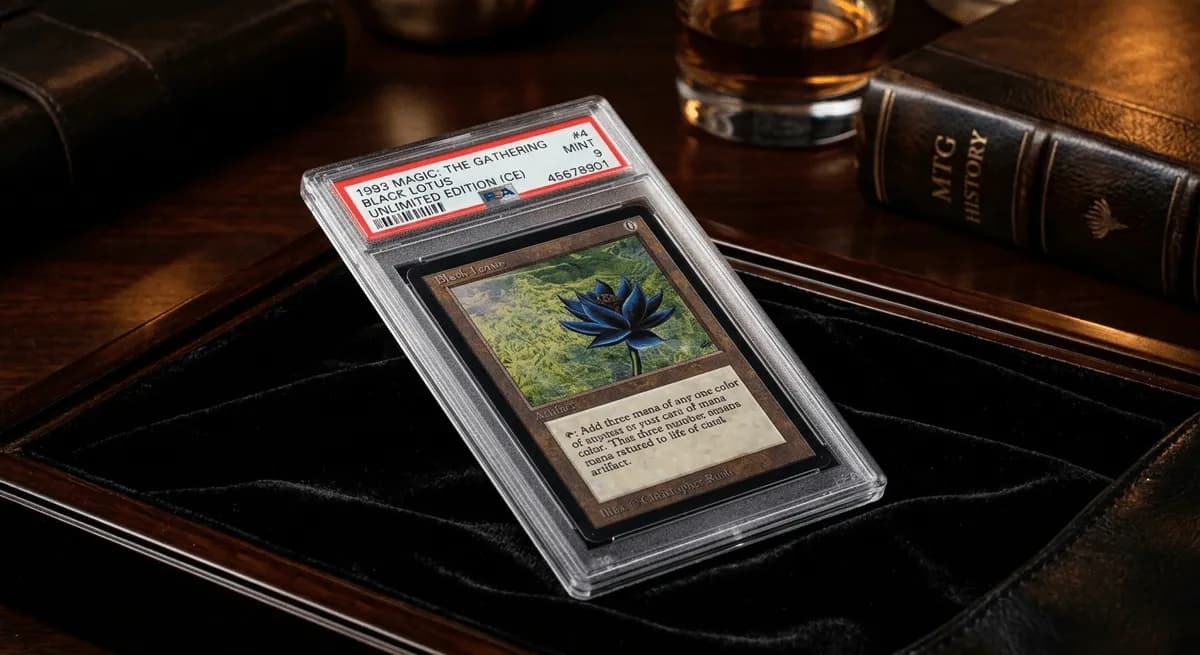
Black Lotus: The $500,000 Grading Case Study
A PSA 10 Alpha Black Lotus is likely the most valuable trading card in the world after the Pikachu Illustrator. In 2021, a PSA 10 Alpha Black Lotus sold for $511,100 — a number that required exceptional conditions across all criteria.
What a PSA 10 Alpha Black Lotus Requires
Centering
Alpha cards have naturally rounded corners, so centering assessment focuses on border width ratios. A gem mint Alpha requires near-perfect print registration despite the primitive 1993 printing technology. Given Alpha's print quality variance, a PSA 10 centering on Alpha is extraordinarily rare.
Corners
Alpha cards have intentionally rounded corners — this is a factory feature, not damage. PSA accounts for this. What they look for is any additional rounding, fraying, or peeling beyond the original rounded specification. A true gem mint Alpha corner must show zero degradation from its original rounded state.
Edges
The black border of Alpha Black Lotus makes edge whitening immediately visible. A PSA 10 requires zero whitening on all four edges — on a 30+ year old card with a black border. The population of Alpha Black Lotus PSA 10s is in single digits for this reason.
Surface
Surface includes scratches, handling marks, the iconic lotus artwork integrity, and the card's distinctive tap/tap symbols. Any play wear — a single shuffle mark or finger smudge — is enough to cap a PSA 10 evaluation. A gem mint Alpha Black Lotus must essentially never have been played or meaningfully handled.
Alpha Black Lotus Price by Grade (2025—“2026)
Grading MTG Dual Lands and Reserved List Cards
The Reserved List — Wizards of the Coast's commitment to never reprint certain cards — makes a specific set of MTG cards permanently scarce. This includes the original dual lands (Tundra, Underground Sea, etc.), which serve as both competitive staples and collector investments.
For dual lands, grading economics are compelling for any copy in near mint or better condition. An Underground Sea in PSA 9 commands roughly 3x the raw NM price; a PSA 10 is closer to 8—“15x. Given that dual lands regularly trade above $500—“$2,000 raw, the grading fee is easily justified.
Reserved List Grading Priority Guide
Modern MTG: What's Worth Grading in 2026?
Modern MTG cards are a more complex grading proposition than vintage. The market for graded modern MTG is smaller than for Pokémon, and the per-card premiums are more modest. That said, certain categories of modern cards have strong graded markets:
Serialized Cards (The List, Special Edition)
Cards with stamped serial numbers (e.g., 001/250) are natural grading candidates. The authentication element alone justifies grading, and gem mint copies of low-numbered serials command significant premiums. Pre-screen before submitting — the serialization survives grading intact.
Showcase and Extended Art Staples
Showcase frames of competitive staples (Force of Will, Brainstorm, Lightning Bolt from special sets) have active graded markets. Focus on cards with raw values above $100 and strong tournament demand.
Borderless Mythics from Premiere Sets
Borderless planeswalkers and mythics from Commander, Modern Horizons, and draft sets above $150 raw are worth pre-screening for grading. The full-frame artwork benefits aesthetically from a clean slab.
PSA vs BGS for MTG: Which Service?
For vintage MTG (Alpha, Beta, Unlimited, Revised), PSA is dominant. The recognition premium is highest and the vintage collector community trusts PSA authentication for these cards most deeply.
For modern MTG, BGS sub-grades provide genuinely useful information about card condition — the breakdown of centering, corners, edges, and surface helps buyers understand exactly what they're getting. CGC is also an excellent budget option with growing MTG collector acceptance.
Grade your MTG cards with AI first.
Master Grade supports Magic: The Gathering cards across all eras.
Related Articles

Day 1 of the 2026 Pokémon Los Angeles Regional Championships now underway featuring Pokémon VGC, Pokémon TCG and Pokémon GO events, tune in to the official livestream feeds here
The 2026 Pokémon Los Angeles Regionals are underway! Learn what this means for card collectors and how MasterGrade AI grading can help maximize value.
May 9, 2026 · 2 min read
Day 1 of the 2026 Pokémon Los Angeles Regional Championships now: what it means for collectors
Day 1 of the 2026 Pokémon Los Angeles Regionals is underway! Learn how the event impacts card values and your collection. Grade smarter with MasterGrade.
May 9, 2026 · 4 min read
Pokémon TCG: Mega Evolution — Chaos Rising launch promo features Ho-Oh, Keldeo and Delphox cards at select retailers
New Pokémon TCG "Mega Evolution — Chaos Rising" promo featuring Ho-Oh, Keldeo, and Delphox cards is here! Learn how it impacts card collectors!
May 9, 2026 · 2 min read
Pokémon TCG: Mega Evolution — Chaos Rising launch promo features: what it means for collectors
The Pokémon TCG Mega Evolution Chaos Rising launch promos are here! Learn how to acquire, assess, and grade these valuable Ho-Oh, Keldeo & Delphox cards.
May 9, 2026 · 4 min read