
How to Spot a Fake Pokemon Card: Complete Authentication Guide
Last reviewed: April 2026. Service information, grading standards, and market context were checked against current hobby guidance and official source pages where applicable.
Pokemon card counterfeits used to be easy to laugh at. The colors were wrong, the fonts were a mess, and the paper felt like cereal-box cardboard. In 2026, that is no longer the full picture. Modern printing tools let counterfeiters produce fakes that look convincing in low-resolution photos, especially to newer collectors. If you buy cards online, trade locally, or source inventory from mixed collections, knowing how to spot a fake Pokemon card is not optional. It is part of basic collector defense.
Why the Pokemon Card Counterfeit Market Is Booming
The economic reason is obvious: high-value Pokemon cards create enormous incentive. Charizard, Blastoise, and other iconic names can be worth hundreds or thousands of dollars depending on set, rarity, and condition. That kind of upside attracts scammers. Vintage grails are obvious targets, but so are modern chase cards such as Charizard VMAX and other splashy rainbow, shiny, or alternate-art style hits that casual buyers recognize instantly.
What changed is quality. Counterfeit printing is better than it used to be. A fake can now imitate foil shine, approximate card thickness, and pass a quick glance in a marketplace listing. The result is a more dangerous counterfeit environment where buyers rely too heavily on photos and too little on process. Scammers also exploit urgency. They price a card just low enough to feel like a deal and count on buyers being afraid to miss out.
That is why authentication knowledge matters. You do not need a lab to catch many fakes, but you do need a structured checklist. When you know what real Pokemon cards are supposed to look and feel like, the warning signs become easier to spot.
How to Authenticate a Pokemon Card at Home (Step by Step)
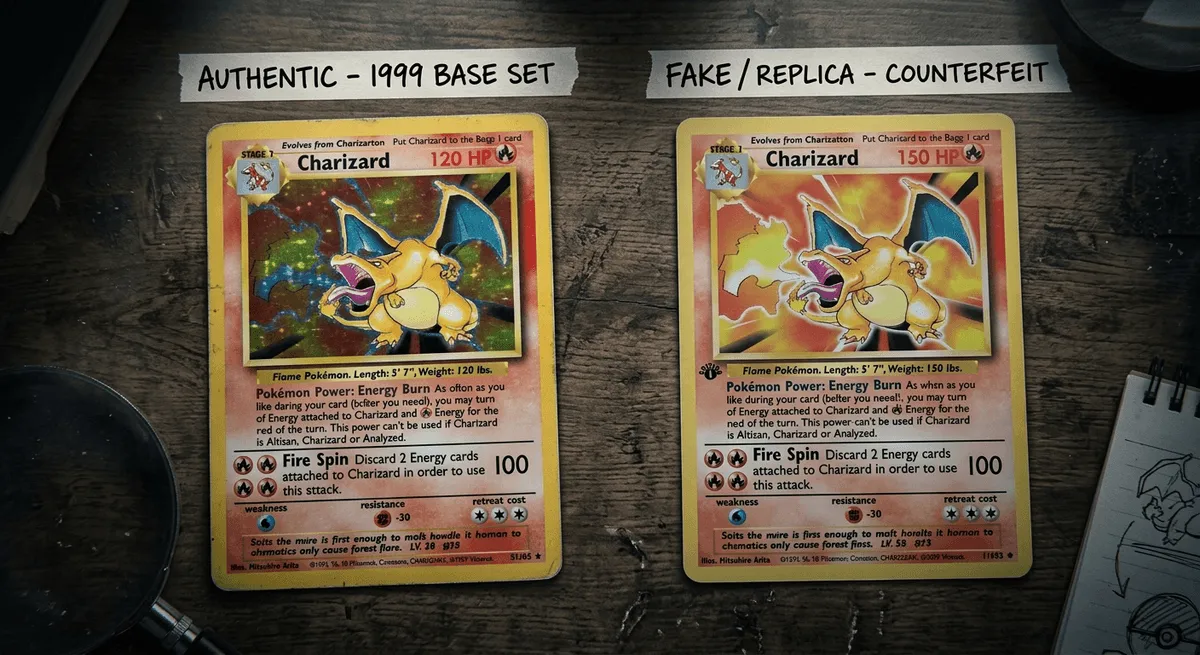
Step 1: Check the holo pattern. Real Pokemon holofoil typically has a recognizable diffraction quality depending on era and card type. Vintage holos, modern textured ultra rares, and special illustration treatments all reflect light in specific ways. Fakes often produce a generic rainbow sheen that looks flashy but wrong. If the holo seems pasted on rather than integrated into the printing, be suspicious.
Step 2: Feel the card texture. Genuine cards have a familiar cardstock density and finish. Textured modern hits should feel intentional, not slippery or artificially embossed. If a card feels waxy, unusually thin, or strangely stiff, that is a warning sign.
Step 3: Check font and spelling. Counterfeits have improved, but subtle font mismatches still happen. Energy symbols may sit awkwardly, attack text may look cramped, or capitalization may be off. Spelling errors are less common than they once were, but they still appear.
Step 4: Inspect the back. The Pokemon card back is one of the most useful diagnostic tools. Compare blue tone, contrast, yellow border richness, and pattern registration to a known authentic card from a similar era. Fakes often miss the exact color balance or look slightly blurry.
Step 5: Use a UV light test. Real cards and fake cards can react differently under UV, especially when counterfeit inks or coatings are involved. This is not a perfect standalone test, but it can support your conclusion when combined with the others. Good authentication is cumulative. The more small red flags you see, the less likely the card is real.
Centering Clues That Reveal Fakes
Centering alone does not prove a fake, but counterfeit cards often get border geometry wrong. The border widths may be slightly inconsistent with the real card design, especially when the counterfeiter copied from an image rather than a production template. If one side looks unnaturally thick and the opposite side unnaturally thin, measure it rather than trusting your eye.
A simple ruler or caliper check can help. Real cards can absolutely be off-center, and 55/45 style border balance is normal enough in the grading world. The issue is not imperfection. It is inconsistency with how the genuine product line behaves. Fakes sometimes produce borders that are wrong in proportion, wrong in cut shape, or wrong in how the art window sits on the card face.
Use centering as one clue among many. If the borders look strange and the holo looks wrong and the back color is off, the case becomes much stronger. Authentication is about pattern recognition, not one magic trick.
Cards Most Commonly Faked — And What to Watch For
Counterfeiters target what people want. Base Set Charizard, Shadowless Charizard, and 1st Edition Charizard remain classic trap cards because even inexperienced buyers know the name. Blastoise and Venusaur from the Base Set family are also common fake targets. On the modern side, expensive eye-catching cards like Charizard VMAX, shiny VMAX variants, and flashy rainbow or alternate-style prints get copied because they are easier to move to casual buyers.
Specific cards like Lugia from high-interest modern sets and other famous chase hits also appear in counterfeit form. Even niche examples such as Shaymin Sky Forme can circulate as fakes when the card image becomes popular online. The danger is not only buying the wrong card. It is buying a fake that looks good enough to stay in your collection until you try to sell or grade it later.
For commonly faked cards, compare against high-quality reference images and known authentic examples. The more expensive the card, the less you should rely on instinct alone.
What to Do If You Find a Fake
Do not try to resell it quietly. That just passes the problem to someone else and can create serious marketplace trouble. Instead, document the card thoroughly. Take clear photos of the front, back, edges, and any suspicious holo or print details. If the card came from TCGPlayer, eBay, or another platform, report it through the marketplace and preserve the listing, receipt, and seller messages.
If you paid through PayPal or a credit card, dispute the transaction if the seller refuses to resolve it. Most platforms take counterfeit claims seriously when you present organized evidence. Keep the communication factual. Avoid emotional arguments and focus on the card—™s defects, authenticity concerns, and policy violation.
Most importantly, label the fake clearly in your own storage if you keep it for reference. The hobby has enough counterfeit circulation already. Do not let a fake drift back into legitimate inventory later by accident.
Grading as Authentication — Does a PSA Label Mean Real?
A lot of collectors assume grading companies function as broad authentication services first and condition graders second. The reality is more nuanced. PSA—™s main role is grading condition for cards it accepts, and while a PSA slab generally gives buyers confidence, the brand does not frame itself as the same kind of explicit counterfeit-detection service some collectors imagine. A PSA holder is reassuring, but it is not the same thing as saying every rejected raw card received a formal counterfeit diagnosis.
CGC Cards is often cited in counterfeit discussions because of more explicit authentication-oriented outcomes in certain cases. If a card is flagged as counterfeit detected or otherwise fails authentication, that language can matter a lot. The important point is that graders are not interchangeable in how collectors interpret their labels and outcomes.
If you are buying raw, pre-screening and self-authentication still matter. If you are unsure about a card before paying grading fees, tools that help inspect centering, surface, and print consistency can at least narrow the field before you escalate. You can also explore practical collector resources on /tips and common grading questions on /faq. When you want a fast first pass on visible condition before making a submission decision, try /grade.
FAQ
What is the easiest way to spot a fake Pokemon card?
Start with the holo pattern, card back colors, print sharpness, and texture. Counterfeits often get one or more of those wrong.
Can fake Pokemon cards feel real?
Some can feel surprisingly close, especially to newer collectors, which is why texture should never be the only test you use.
Are vintage cards more commonly faked than modern ones?
Iconic vintage cards are heavily faked, but expensive modern chase cards are targeted constantly as well.
Does a PSA slab guarantee a card is real?
A PSA slab adds confidence, but collectors should still understand the difference between condition grading and explicit authentication language.
What should I do if I accidentally bought a fake?
Document it, report it to the platform, and dispute the transaction through the payment method if needed. Do not try to resell it.
Need a fast condition pre-screen before you pay to grade? Try /grade.
Want to know if your card is worth grading before you pay submission fees?
Try MasterGrade AIRelated Articles

Japanese Pokemon Cards: Grading and Value Guide
A guide to grading Japanese Pokémon cards, including condition standards, market demand, and why top Japanese copies can command strong premiums.
April 1, 2026 · 8 min read
Pokemon Sealed Products as Investments: What to Buy in 2026
A guide to evaluating Pokémon sealed products for investment, including authenticity checks, condition risks, and long-term value drivers.
April 1, 2026 · 8 min read
Pokemon VSTAR, VMAX and V Cards: Modern Grading Standards
Learn what matters most when grading Pokémon VSTAR and VMAX cards, from centering and print quality to the premiums attached to top grades.
April 1, 2026 · 8 min read
Sealed Pokemon Booster Boxes: To Grade or Not to Grade
A guide to sealed Pokémon booster box investing covering factory-wrap checks, condition standards, and the risks that separate average boxes from premium ones.
April 1, 2026 · 8 min read