
How to Build a Card Grading Business From Home
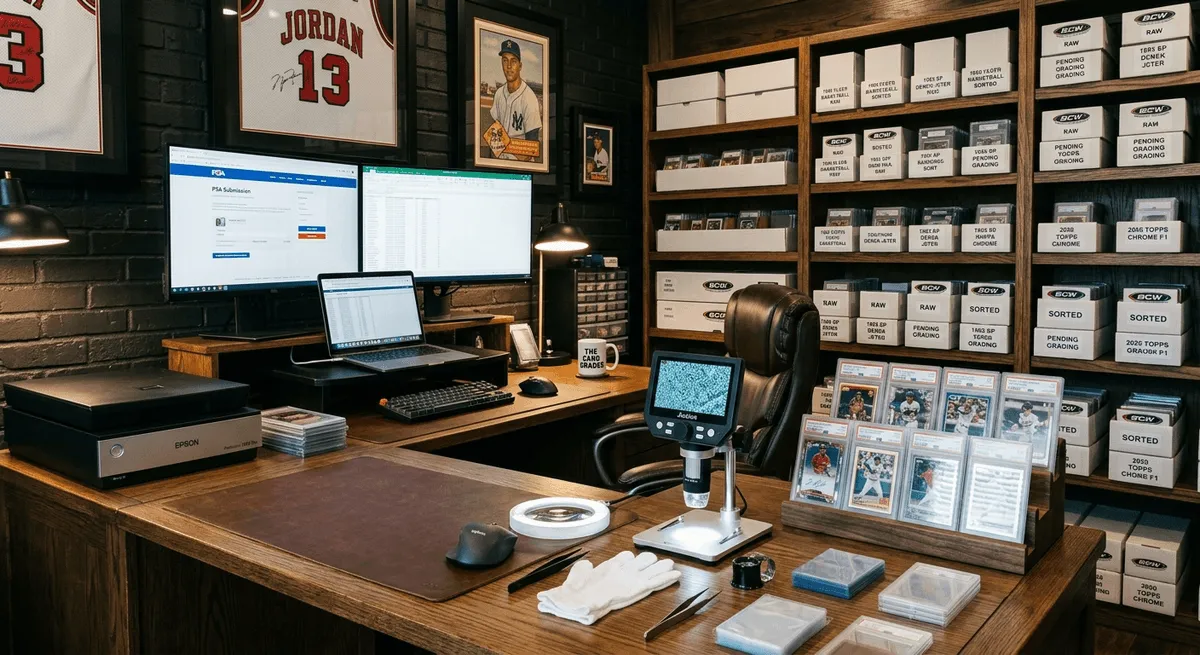
Last reviewed: April 2026. Service information, grading standards, and market context were checked against current hobby guidance and official source pages where applicable.
Starting a card grading business from home sounds simple on the surface: inspect cards, submit the best ones, and charge for the service. In reality, the businesses that last are the ones that treat grading as a process business, not a hobby with a Venmo link. In 2026, collector demand is strong, grading backlogs still create friction for casual submitters, and AI tools make pre-screening faster than ever. That combination creates real opportunity for a focused side hustle.
Why Start a Card Grading Side Business in 2026?
The collectible card market is larger and more diversified than it was during the pandemic boom. Pokemon remains the headline giant, but sports, Dragon Ball, Digimon, One Piece, Lorcana, and other categories have created constant demand for grading guidance. Many collectors own cards that might be worth grading, but they do not want to learn submission portals, pack shipping methods, declared value rules, or the difference between a likely 8 and a likely 10. That gap is a business opportunity.
PSA and other grading companies also create a natural bottleneck. Even when turnaround times improve, the process still feels intimidating to new customers. People worry about damaging cards during prep, choosing the wrong service level, or paying grading fees on cards that had no real shot at a premium grade. A home grading business can remove that friction by acting as a local expert and submission manager.
The biggest 2026 advantage is AI pre-screening. In the past, small operators had to rely entirely on experience and subjective judgment. Now tools like MasterGrade AI can help identify centering problems, obvious corner wear, and visible surface issues before a card ever goes into a semi-rigid holder. That reduces costly mistakes and allows you to build a service around smarter triage. You are not just mailing cards. You are helping clients avoid bad submissions, which is where much of the value lives.
Essential Equipment for a Home Grading Business
You do not need a commercial studio to start, but you do need consistency. A modern phone camera such as an iPhone 14 or newer is sufficient for many workflows, especially when paired with stable lighting. A simple LED light box in the $30 to $100 range can dramatically improve inspection quality by reducing glare and shadows. Add a macro lens attachment or dedicated close-focus setup if you want to examine corners and surfaces in more detail. The goal is not cinematic beauty. It is repeatable clarity.
A color-accurate display matters more than people think because subtle whitening, print streaking, and edge wear can disappear on bad screens. On the software side, MasterGrade is useful for pre-screening and triage, while Photoshop or similar image tools help you zoom, compare copies, and document flaws for clients. Clean digital workflow translates directly into better recommendations.
Do not neglect physical storage. You need penny sleeves, semi-rigid card savers, top loaders, team bags, labels, and a clean system for intake and return. Binders are useful for temporary organization, but climate control is equally important. Heat, humidity, smoke, pets, and dust are all enemies of card condition. If clients trust you with valuable collectibles, your workspace has to reflect that trust. Clean handling and organized storage are part of the product.
How to Set Your Pricing
Pricing should reflect the type of value you provide, not just the minutes you spend. A pre-screening service can range from free to about $5 per card if you are using MasterGrade AI and your goal is to acquire customers or generate volume. Some businesses offer the first few cards free, then charge for larger batches. That can work well because it lowers the barrier to entry while still monetizing more serious collectors.
For a physical submission-handling service, many home operators charge roughly $15 to $30 per card on top of the grading fees themselves. That price covers intake, condition review, documentation, packaging, paperwork, client communication, and submission management. The more trust and expertise you build, the easier it is to support the higher end of that range. Rush tiers can also add meaningful revenue. A client who wants a two-week turnaround or immediate prep before a show may pay more than a client comfortable waiting six months on a bulk economy batch.
Be careful not to underprice because you are afraid to charge. If you save a customer from submitting ten weak cards, you may have saved them far more than your service fee. That is real value. Your pricing model should reflect the money, time, and mistakes you prevent.
Finding Clients
The easiest clients are already in the hobby. Start with local card shops, trade nights, and regional shows. Many shop owners do not want to manage submissions themselves, but they are happy to refer a trustworthy specialist. Facebook groups and Discord servers are also strong channels because collectors constantly ask versions of the same question: is this worth grading? If you can answer clearly and show your process, you become useful fast.
eBay seller partnerships are another underrated channel. Small sellers often sit on inventory that could benefit from better selection and occasional grading, but they do not have time to inspect everything. Offer to pre-screen lots, identify submission-worthy cards, and split the upside through a service fee or repeat relationship. Over time, referral networks become the real engine. One happy customer who gets a surprise PSA 10 can bring you five more people.
The trick is to sell trust, not hype. Do not promise gem mints. Promise careful screening, clean handling, and honest recommendations. That reputation compounds.
Managing the PSA/BGS Submission Process
Operational discipline is what separates a real grading business from a hobbyist mailing stack. Bulk submissions are often the best economics because grouping twenty or more cards can reduce per-card cost and make shipping more efficient. But bulk only works if you have a reliable filter. This is where AI helps again. If your process only advances cards that pre-screen at roughly 8.0 or better, you cut down on waste and protect client expectations.
Build a clear intake workflow: photograph each card, log ownership, record declared value, confirm grading company and service level, then sleeve and card-save the cards consistently. When using the PSA submission portal, double-check item descriptions, service tiers, and declared values. Administrative mistakes are expensive and embarrassing. The portal itself is not difficult, but accuracy matters because clients assume you know what you are doing.
Keep communication simple and frequent. Tell clients when cards are received, when they are pre-screened, when they are submitted, and when grades post. Most customer anxiety comes from silence. Good updates make you look professional even before the package comes back.
Marketing Your Grading Service
You do not need a massive following to market a grading business. You need repeatable proof. Before-and-after style content works well, especially when you explain why a specific card was chosen for grading and what condition traits mattered. Social media clips showing centering differences, corner wear, or slab reveals can build credibility quickly, as long as you avoid exposing customer names, addresses, or sensitive order information.
YouTube grading breakdowns and TikTok card reveal content work because collectors love process. They want to know why one Charizard got a 10 and another got a 9. If you can teach while you market, you do both jobs at once. Local card shows are also powerful because face-to-face trust is easier to build than algorithmic trust. A simple tabletop setup with lights, sleeves, examples, and a QR code to your intake form can generate real business.
Think content first, advertising second. Clear demonstrations of your method will usually outperform generic sales language.
Legal and Financial Considerations
If you are handling other people—™s valuables, treat the business like a business. Depending on where you operate, that may mean registering a small business entity, collecting appropriate taxes, and separating business banking from personal spending. Liability insurance is worth serious consideration if you are storing high-value cards even temporarily. One accident or shipping dispute can erase months of profit.
Use written intake terms and simple contracts. Every client file should identify the cards received, the selected service level, who is responsible for grading fees, what happens if a package is delayed, and how return shipping will be handled. Also build a tracking system, whether it is a spreadsheet, lightweight CRM, or project board. If you cannot instantly answer where a client—™s cards are, the business will feel shaky.
Professionalism is not overhead. It is part of the product. The more valuable the cards, the more your organization becomes the service clients are actually paying for.
FAQ
Can I start a grading side hustle from home?
Yes. Many small operators begin with a clean workspace, a good camera setup, organized intake process, and a focus on pre-screening plus submission management.
Do I need expensive gear?
No. A modern phone, good lighting, basic storage supplies, and reliable inspection workflow are enough to start professionally.
How much should I charge?
Pre-screening often ranges from free to $5 per card, while full submission handling commonly lands around $15 to $30 per card plus grading fees.
How do I reduce bad submissions?
Use structured condition checks and AI pre-screening so only cards with a realistic grading outcome move forward.
What matters most for repeat business?
Trust. Clear communication, careful handling, accurate paperwork, and honest advice matter more than flashy branding.
Want to test the kind of tool that can power your pre-screening workflow? Try /grade.
Want to know if your card is worth grading before you pay submission fees?
Try MasterGrade AIRelated Articles

Day 1 of the 2026 Pokémon Los Angeles Regional Championships now underway featuring Pokémon VGC, Pokémon TCG and Pokémon GO events, tune in to the official livestream feeds here
The 2026 Pokémon Los Angeles Regionals are underway! Learn what this means for card collectors and how MasterGrade AI grading can help maximize value.
May 9, 2026 · 2 min read
Day 1 of the 2026 Pokémon Los Angeles Regional Championships now: what it means for collectors
Day 1 of the 2026 Pokémon Los Angeles Regionals is underway! Learn how the event impacts card values and your collection. Grade smarter with MasterGrade.
May 9, 2026 · 4 min read
Pokémon TCG: Mega Evolution — Chaos Rising launch promo features Ho-Oh, Keldeo and Delphox cards at select retailers
New Pokémon TCG "Mega Evolution — Chaos Rising" promo featuring Ho-Oh, Keldeo, and Delphox cards is here! Learn how it impacts card collectors!
May 9, 2026 · 2 min read
Pokémon TCG: Mega Evolution — Chaos Rising launch promo features: what it means for collectors
The Pokémon TCG Mega Evolution Chaos Rising launch promos are here! Learn how to acquire, assess, and grade these valuable Ho-Oh, Keldeo & Delphox cards.
May 9, 2026 · 4 min read