
Beckett Grading Services (BGS) Review: Is It Worth It in 2026?
Last reviewed: April 2026. Service information, grading standards, and market context were checked against current hobby guidance and official source pages where applicable.
Beckett Grading Services still occupies a special place in the grading world. Even collectors who mostly submit to PSA will admit that a Beckett slab means something different: more information, more visual prestige on the label, and in the case of a Black Label, a level of exclusivity few cards ever reach. But —œworth it— depends on why you are grading. BGS is not always the best answer for resale, speed, or mainstream liquidity. It is, however, still one of the most important options in the hobby.
What Is BGS Grading?
Beckett Grading Services was founded in 1999 as an extension of the Beckett brand built by Dr. James Beckett and his influential sports card price guides. The company entered grading with a strong reputation among sports collectors, then expanded across Pokemon, Magic, and other TCG categories as the hobby matured. In 2020, Beckett was acquired by Silverton Partners, a move that kept the brand alive but also brought a fresh round of scrutiny around operations, service levels, and long-term positioning.
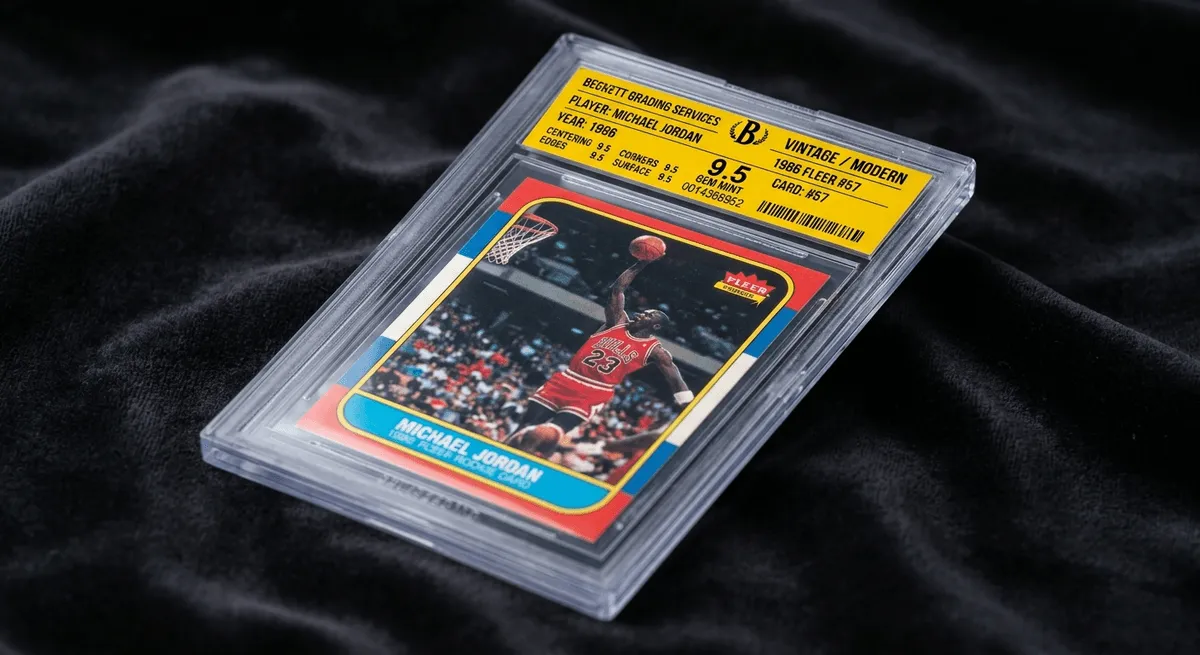
BGS differs from PSA and CGC in one major philosophical way: it wants to show its work. Rather than offering only a single overall grade, BGS highlights sub-grades that tell you how the card performed in centering, corners, edges, and surface. That transparency is the core of Beckett—™s appeal. For collectors who care about condition details instead of just the final number, BGS often feels more informative and more satisfying than a simpler label.
In 2026, BGS remains particularly relevant for sports cards, premium modern TCG cards, and collectors chasing the prestige of pristine examples. The brand may not dominate resale the way PSA does, but it still commands attention wherever condition nuance matters.
The BGS Grading Scale Explained
BGS uses a 1 to 10 scale with half-point increments, which gives collectors more granularity than a whole-number-only system. Common grades include 8.0, 8.5, 9.0, 9.5, and 10.0, with the hobby historically treating BGS 9.5 as the classic —œgem mint— benchmark for many cards. At the very top sits the famous 10.0 designation, including the Black Label tier, which is reserved for exceptionally strong examples.
That half-point structure matters because it creates meaningful separation between cards that might all look —œmint— to a casual buyer. A BGS 8.5 and a BGS 9.5 can appear similar at a glance, but the label signals very different market confidence. On expensive cards, that extra gradation helps buyers justify price differences that might feel arbitrary under a simpler grading framework.
The main downside is complexity. New collectors can find Beckett labels intimidating because the market talks about 9.5s, pristine 10s, Black Labels, and sub-grade combinations as if they were separate currencies. In practice, that is exactly what they become. A BGS slab is not just a number. It is a condition profile, and buyers often price it accordingly.
BGS Sub-Grades — The BGS Advantage
The true Beckett advantage is the four-part breakdown: Centering, Corners, Edges, and Surface. Each category receives its own score, and those scores combine into the overall grade. This gives collectors something PSA cannot: a quick way to understand why the card landed where it did. A 9.5 with 10 corners but 9 centering tells a very different story from a balanced 9.5 across the board.
Reading a BGS label becomes easy once you know what to look for. The main grade sits prominently in the center. Beneath it, the four sub-grades reveal the card—™s strengths and weaknesses. For buyers, that is useful because it clarifies whether the card has a fixable aesthetic issue, such as mild centering, or a more serious one, such as surface flaws that will always show. For submitters, it is feedback you can use to improve future pre-screening.
The Black Label sits at the top of the Beckett prestige ladder. Traditionally, collectors use the term for cards with ultra-elite sub-grades, and in hobby conversation it signals a card that is effectively the gold standard for modern perfection. Because all four areas must be exceptional, the label is dramatically harder to earn than a routine mint grade. That difficulty is why Black Labels carry such emotional and financial weight.
BGS 10 Gem Mint vs PSA 10 — What—™s the Difference?
When collectors compare BGS and PSA, they are usually comparing a Beckett 10 or 9.5 to a PSA 10. PSA allows 55/45 centering on the front for a Gem Mint 10, assuming the rest of the card is strong. A Beckett Black Label expectation is materially tighter because the sub-grades have to stay elite across every category. In plain English: getting a PSA 10 is hard, but getting the most prestigious Beckett label is harder.
Market perception follows that difficulty. PSA 10 is more widely recognized and often easier to sell because the buyer pool is larger. Many collectors default to PSA for liquidity, registry appeal, and headline prices. Beckett, however, carries special prestige at the very top. A Black Label on a high-demand Pokemon or sports rookie can command a premium that even PSA 10s struggle to match because buyers view it as a rarer accomplishment.
That does not mean Beckett is always the financially superior path. Plenty of ordinary cards sell better in PSA holders because the broader market is conditioned to trust and chase that label. Beckett becomes most compelling when the card is already excellent and you want the market to recognize just how excellent it is.
BGS Pricing and Turnaround Times (2026)
In 2026, Beckett—™s pricing generally slots into a few recognizable tiers. Economy-style service sits around $25 per card, with longer service windows that can extend toward a month or more. A more popular value-tier service often lands around $75 per card and offers faster handling for collectors who want a better balance between cost and speed. Walkthrough or premium priority service can reach $200+ per card for urgent, high-value submissions. As always, confirm the current tier menu on Beckett's site before you submit because service names and pricing can move.
On paper, these numbers are competitive with PSA at several tiers, especially if you value sub-grades. In practice, the real calculation includes your exit plan. If PSA will command a stronger resale multiple on the same card, the cheaper or equally priced Beckett service may not actually be the best business decision. Conversely, if you believe your card has Black Label potential or you want sub-grade transparency for a personal collection, Beckett—™s pricing can make perfect sense.
Turnaround expectations matter too. Beckett has improved in some cycles and frustrated submitters in others. Before sending a large order, treat published turnaround times as targets, not guarantees. If speed is mission-critical, confirm current service performance before committing.
What BGS Does Well — Pokemon, Sports, MTG
Beckett—™s sports card credibility remains one of its strongest assets. For collectors who grew up with Beckett price guides, the slab still carries heritage value that PSA cannot fully replace. That history matters most on premium rookies, autographs, and cards where sub-grades help justify a major purchase.
In Pokemon, BGS is often attractive for ultra-clean modern cards. Well-centered pack-fresh releases can stack up nicely in Beckett holders, and some collectors specifically hunt BGS 9.5 or pristine labels because they feel more selective than ordinary gem-mint slabs. In MTG, Beckett still draws attention on iconic foils, Reserved List pieces, and power cards where a pristine condition profile can add serious cachet.
In all three categories, Beckett shines when the card itself is already premium. BGS is not usually the place to send questionable borderline copies. It is where you send the card you think might truly be special.
BGS Quirks and Known Issues
No grading company is perfect, and Beckett has its own quirks. The slabs are slightly smaller and visually denser than PSA holders, which some collectors love and others dislike. The label design feels premium, but it also makes even tiny defects feel more —œon display— because the sub-grades invite scrutiny.
There is also a long-running hobby complaint that BGS can be somewhat generous on centering in certain cases while being unexpectedly strict elsewhere. Whether that is entirely fair is debatable, but the perception exists, and perception affects resale. Customer service has also received mixed reviews, particularly in the years following the Silverton acquisition. Some submitters report smooth experiences; others describe communication gaps and inconsistent timelines.
That does not make Beckett a bad choice. It just means you should use Beckett intentionally. Send the right card, for the right reason, with the right expectations. If you do, BGS can still be one of the most satisfying slabs in the hobby.
FAQ
Is BGS better than PSA?
It depends on your goal. PSA is usually better for broad resale liquidity, while BGS is better for sub-grades and prestige at the very top end.
What is the difference between BGS 9.5 and BGS 10?
A 9.5 is an elite gem-mint grade, while a 10 or Black Label represents an even rarer level of condition excellence.
Do BGS cards sell for more than PSA cards?
Usually not at ordinary grades, but a Beckett Black Label can outperform PSA 10 on the right card because it is so difficult to obtain.
Are BGS sub-grades worth paying for?
Yes if you want condition transparency, plan to keep the card, or believe the detailed label will help justify value to buyers.
Should I send borderline cards to BGS?
Usually no. Beckett is best for strong, carefully pre-screened copies where you are chasing a premium result.
Thinking about Beckett? Use /grade as an AI pre-screening pass first so you only submit cards with real Beckett-level upside.
Want to know if your card is worth grading before you pay submission fees?
Try MasterGrade AIRelated Articles
CGC Card Grading Review: How It Compares to PSA and BGS
A 2026 review of CGC card grading, including strengths, resale considerations, turnaround expectations, and how CGC compares with PSA and BGS.
April 1, 2026 · 8 min read
Day 1 of the 2026 Pokémon Los Angeles Regional Championships now underway featuring Pokémon VGC, Pokémon TCG and Pokémon GO events, tune in to the official livestream feeds here
The 2026 Pokémon Los Angeles Regionals are underway! Learn what this means for card collectors and how MasterGrade AI grading can help maximize value.
May 9, 2026 · 2 min read
Day 1 of the 2026 Pokémon Los Angeles Regional Championships now: what it means for collectors
Day 1 of the 2026 Pokémon Los Angeles Regionals is underway! Learn how the event impacts card values and your collection. Grade smarter with MasterGrade.
May 9, 2026 · 4 min read
Pokémon TCG: Mega Evolution — Chaos Rising launch promo features Ho-Oh, Keldeo and Delphox cards at select retailers
New Pokémon TCG "Mega Evolution — Chaos Rising" promo featuring Ho-Oh, Keldeo, and Delphox cards is here! Learn how it impacts card collectors!
May 9, 2026 · 2 min read